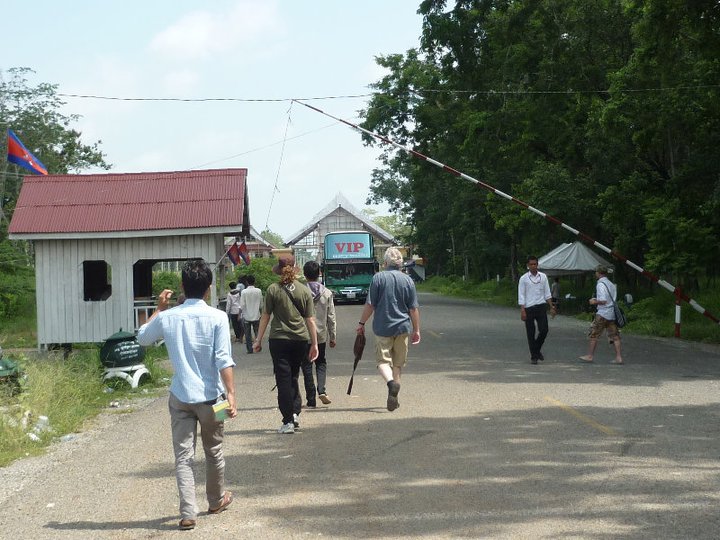
We met with Jan, iced coffee in hand. Laura had gone to the loo and claimed that she needed to find her boyfriend for some cash when both groups intersected each other with broad grins, knowing we were looking at our new travelling companions.
We picked up yet more coffees as luckily for us Jan had a big night previously with a useful contact in the social development world and was feeling pretty bad also. We set off across the bus station to another terminal dedicated to jeeps and minivans that take you to more remote villages off the beaten track. Within an hour of introductions to ourselves and the project set off to Nong Khiaw (70,000 kip or £5.80) through the dusty outskirts of Luang Prabang, through limestone extrusions that towered dense trees overhead. Some of these seemed to hang off a black face so steep and at such an angle that it was not possible that it would remain.
We rattled over potholes, rocking violently, but continuing our conversation, as it all seemed normal. The others in the van commented on the ‘conditions’ and gripped on to their seats before we emerged on an asphalt road. This wound through what seemed like endless miles of open country hidden behind jungle wrapped mountains. Jan pointed out where a slip road was being built by the Chinese, without consent having passed by the Laos government such was their arrogance. He pulled out planning documents that detailed a hydroelectric plant situated on seven parts of the Nam Ou river we were driving parallel to and would swamp in stagnated water. Watching it gleam in the sunlight, bubbling and carving like a maroon snake through the mountains, swollen and coloured by the current wet season, it seemed inconceivable. The river would stop and livelihoods drown under inert water. Around 12 villages would be affected, including 3 that Jan has worked on and including the one we would be working at Hatsa.
The reality of such a project suddenly having such an impact on your own activity gave new perspective, but this would increase in the weeks to come. At this point we just listened and learnt as much as possible. The trees lining the river were all teak trees, a staple building wood for the country. Scattered around and above this were bamboo clusters intermingled with banana trees, yucca tress and other native varieties. Yet the majority was cultivated. So the wilderness we were staring at in awe, as deep jungle was actually still man-made. It was only over the hills far away from the hill tribes where you could start to find virgin jungle.
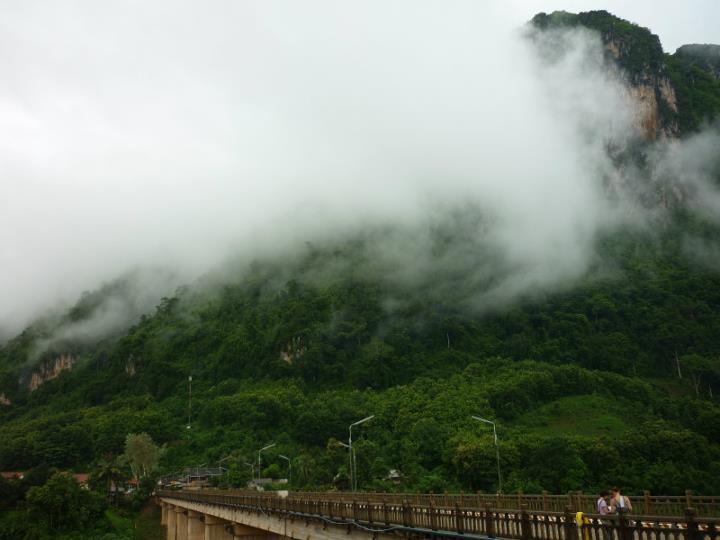 After 3 hours we hit the start of the dirt road and after an hour of rumbling along, passing rice cultivators with their massive blades, my head nodding painfully on the seat in front we reached Nong Khiaw. Jan expertly organised a tuk tuk to the other side of the river where the town was with the other travelers in the minivan and for 5,000 kip each we were dropped in the centre of town in 5 minutes, on the bank of the large Nam Ou river, where even more impressive peaks overwhelmed us. We headed directly to Meexai Guesthouse that has bungalows made from bamboo on stilts for just 20,000 kip per night for the whole place. Flowers and grass
 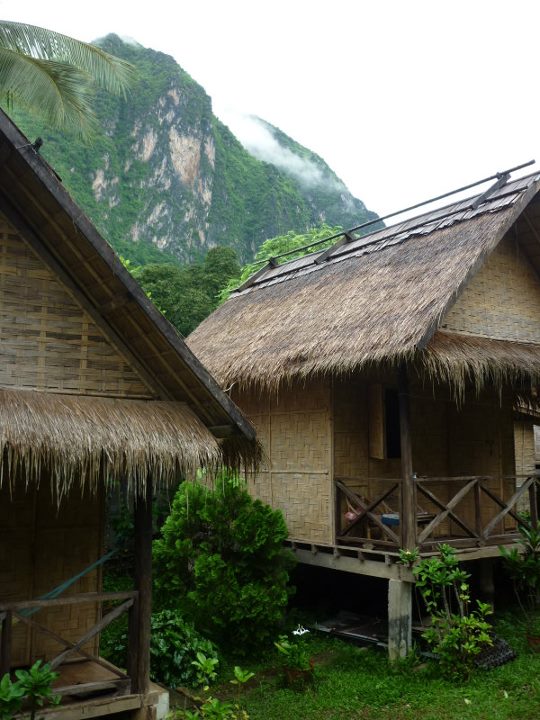 and mud adorned the outside environment as it started to spit with rain, black clouds rapidly flowing over the mountain peaks like a dolphin through water. The inside of the bungalow was well appointed as it was actually clad with plaster board, an effort usually too great for the Laotians. The bathroom was tiled and with a hammock outside on the verandah we were extremely happy. We also felt luck as our expenses were covered and so we were heading to a place that we otherwise could not have reached with our budget restrictions. We had agreed that we would really push ourselves off the beaten track and do something that challenged us to the limits and here we were, we were doing it. Anticipating excitement rushed through us as we sat taking in the scene. After a needed nap we headed over to grab something to eat from a restaurant that looked over the river and the port, which we would be stood at tomorrow to pick up a public boat to Muang Ngoi. For now however we ate well; pizza bread, noodle soup, Aurlam (a local dish made of meat, dill and wild mushrooms), fried rice and local coffee formed the veritable spread we needed with lack off food the night before and breakfast. The view was impressive as the clouds rolled in and dissipated, sun beams highlighted different parts of the landscape in ways artists dream of. The river was exceptionally high and the boats roared into life and cut across the river to begin its crawl upstream on the near side of the bank.
Satisfied we headed back to our jungle homes, daintily maneuvering across the wet, red clay and negotiated the water channels, carved into the supposed paths. Nong Khiaw is quite far off the usual traveler route, but is still heavily catered towards the ‘intrepid tourists’. This includes a newly constructed traditional steam bath and massage parlor. We booked this for the evening and relaxed for the rest of the day. As night fell we were served tea in a wooden house and wrapped ourselves up to protect against mosquitoes. We each had an hours massage (40,000 kip or £3.70) and sat in a small wooden shed filled with herbal steam (15,000 kip). Whilst taking a break outside we bumped into Francesca, a girl we met in Tad Lo a month ago, as she walked up in a towel, having just had a massage! It is funny how you end up meeting up with the same people you get along with en route, as they tend to have a similar method of travel and the same ideas as you.
We hugged and all climbed back into the steam bath excitedly chatting about what we had been up to. This continued after our massage as we went for a beer to catch up. The next day we all met again for breakfast before catching our boat further north. Jan met with the head of education for the district, as he was supporting the Bamboo School, given that it is a foundation that focuses solely on educational development. After we were introduced we set off and were soon packing ourselves on a boat with around 30 others. We took the initiative to sit up front and I sat on cool chest that meat I had my legs dangling overboard in the sun, instead of being cramped with everyone else.
and mud adorned the outside environment as it started to spit with rain, black clouds rapidly flowing over the mountain peaks like a dolphin through water. The inside of the bungalow was well appointed as it was actually clad with plaster board, an effort usually too great for the Laotians. The bathroom was tiled and with a hammock outside on the verandah we were extremely happy. We also felt luck as our expenses were covered and so we were heading to a place that we otherwise could not have reached with our budget restrictions. We had agreed that we would really push ourselves off the beaten track and do something that challenged us to the limits and here we were, we were doing it. Anticipating excitement rushed through us as we sat taking in the scene. After a needed nap we headed over to grab something to eat from a restaurant that looked over the river and the port, which we would be stood at tomorrow to pick up a public boat to Muang Ngoi. For now however we ate well; pizza bread, noodle soup, Aurlam (a local dish made of meat, dill and wild mushrooms), fried rice and local coffee formed the veritable spread we needed with lack off food the night before and breakfast. The view was impressive as the clouds rolled in and dissipated, sun beams highlighted different parts of the landscape in ways artists dream of. The river was exceptionally high and the boats roared into life and cut across the river to begin its crawl upstream on the near side of the bank.
Satisfied we headed back to our jungle homes, daintily maneuvering across the wet, red clay and negotiated the water channels, carved into the supposed paths. Nong Khiaw is quite far off the usual traveler route, but is still heavily catered towards the ‘intrepid tourists’. This includes a newly constructed traditional steam bath and massage parlor. We booked this for the evening and relaxed for the rest of the day. As night fell we were served tea in a wooden house and wrapped ourselves up to protect against mosquitoes. We each had an hours massage (40,000 kip or £3.70) and sat in a small wooden shed filled with herbal steam (15,000 kip). Whilst taking a break outside we bumped into Francesca, a girl we met in Tad Lo a month ago, as she walked up in a towel, having just had a massage! It is funny how you end up meeting up with the same people you get along with en route, as they tend to have a similar method of travel and the same ideas as you.
We hugged and all climbed back into the steam bath excitedly chatting about what we had been up to. This continued after our massage as we went for a beer to catch up. The next day we all met again for breakfast before catching our boat further north. Jan met with the head of education for the district, as he was supporting the Bamboo School, given that it is a foundation that focuses solely on educational development. After we were introduced we set off and were soon packing ourselves on a boat with around 30 others. We took the initiative to sit up front and I sat on cool chest that meat I had my legs dangling overboard in the sun, instead of being cramped with everyone else.
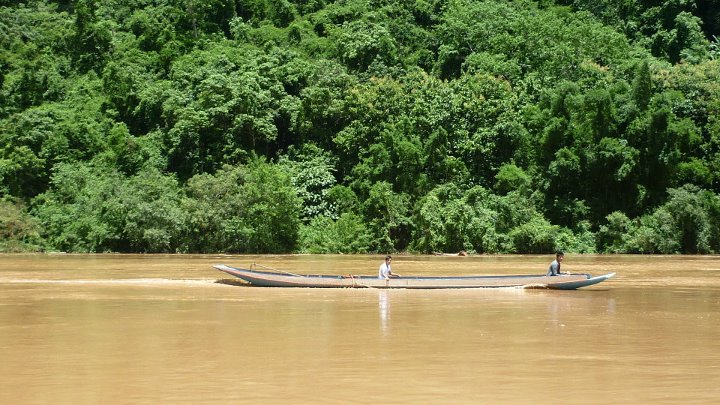 The journey was immense and so beautiful, the river was extremely powerful and whole trees were being carried downstream with the force of the surging water. Eddies span off and took dead bamboo with it, hazards to the propeller that the driver had to avoid. The driver seemed quite crazed however and whenever a local needed to get off he would do a bad job at judging how fast to approach the bank. We assumed this was a big night on the Lao Lao (traditional Lao spirit). At one point he crashed up on the bank in a rage, shouting at the person sat at the back, as the boat’s frame contorted. He shouted at me to get off with one other, while he stripped off to his Y-fronts and jumped in the water to fix something at the rear. We waited for 15 minutes as he dashed around wildly, before we were ordered back on. Sat in the sun, with wind in your hair, the motor roaring as you take in the non-stop rock formations passing by and observing the vegetation with fresh eyes, knowing what the different sections are made of is unforgettable.
After an hour we turned abruptly to the right hand bank towards another, smaller village. Other wooden long boats congested the port, so men who were previously having a wash began maneuvering them to make space for our vessel. We climbed out at the bottom of the steps, excited by this new place, even more isolated in the mountains. I grabbed all the bags while Jan set off to the guesthouse he uses everytime he comes this way, which was great as he has been to many during the year and half he has been travelling up and down the Nam Ou and so secured us the best rooms facing the river (20,000 again) at Sailom Guesthouse. Our hammocks were laid out within 5 minutes of us landing, while people were still milling around trying to find somewhere and price compare.
We set out a little while after to buy a multipack of locally produced drinking water, which costs 2,000 kip each instead of 5,000- 8,000 for a Pepsi or Nestle brand, which is a completely unethical choice to be avoided, but an issue we will not go into! I also picked up some local “A” cigarettes and some fruit before retiring for another afternoon nap. We were to stay in Muang Ngoi for 2 nights, as we needed to rendez vous with a boat that Jan had privately hired.
This was to be loaded up with the blocks we needed to build a toilet block for the school in Hatsa, which was destroyed some weeks ago by a massive mango tree. We would also meet our translator onboard and go to fetch some tools that we would need from another ‘project village’ called Sup King, where the school was still being built.
The journey was immense and so beautiful, the river was extremely powerful and whole trees were being carried downstream with the force of the surging water. Eddies span off and took dead bamboo with it, hazards to the propeller that the driver had to avoid. The driver seemed quite crazed however and whenever a local needed to get off he would do a bad job at judging how fast to approach the bank. We assumed this was a big night on the Lao Lao (traditional Lao spirit). At one point he crashed up on the bank in a rage, shouting at the person sat at the back, as the boat’s frame contorted. He shouted at me to get off with one other, while he stripped off to his Y-fronts and jumped in the water to fix something at the rear. We waited for 15 minutes as he dashed around wildly, before we were ordered back on. Sat in the sun, with wind in your hair, the motor roaring as you take in the non-stop rock formations passing by and observing the vegetation with fresh eyes, knowing what the different sections are made of is unforgettable.
After an hour we turned abruptly to the right hand bank towards another, smaller village. Other wooden long boats congested the port, so men who were previously having a wash began maneuvering them to make space for our vessel. We climbed out at the bottom of the steps, excited by this new place, even more isolated in the mountains. I grabbed all the bags while Jan set off to the guesthouse he uses everytime he comes this way, which was great as he has been to many during the year and half he has been travelling up and down the Nam Ou and so secured us the best rooms facing the river (20,000 again) at Sailom Guesthouse. Our hammocks were laid out within 5 minutes of us landing, while people were still milling around trying to find somewhere and price compare.
We set out a little while after to buy a multipack of locally produced drinking water, which costs 2,000 kip each instead of 5,000- 8,000 for a Pepsi or Nestle brand, which is a completely unethical choice to be avoided, but an issue we will not go into! I also picked up some local “A” cigarettes and some fruit before retiring for another afternoon nap. We were to stay in Muang Ngoi for 2 nights, as we needed to rendez vous with a boat that Jan had privately hired.
This was to be loaded up with the blocks we needed to build a toilet block for the school in Hatsa, which was destroyed some weeks ago by a massive mango tree. We would also meet our translator onboard and go to fetch some tools that we would need from another ‘project village’ called Sup King, where the school was still being built.
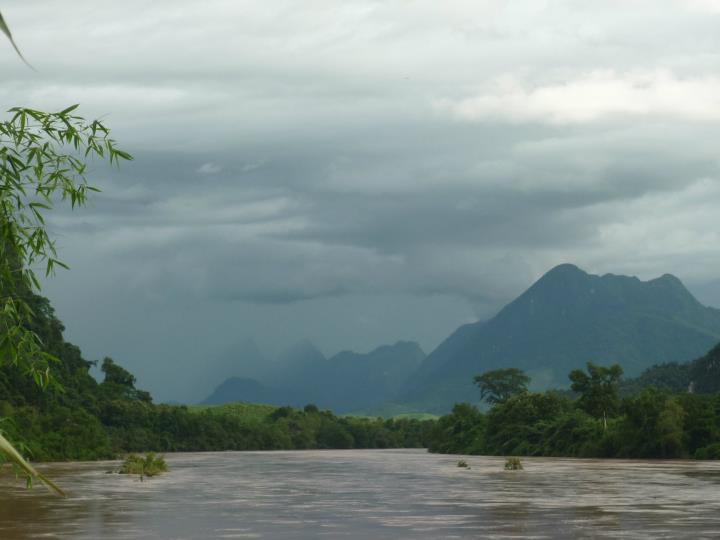 We met Jan at one of the numerous bars lining the riverfront, heavily catering towards tourists. If you want a cocktail though the Riverside is the place you need. Despite being off-season there were still a fair number of people around and making it this far up the river, a feat the guidebooks suggested was rare. Nevertheless everyone from backpackers, to older people heading out on treks and even families with young children were walking around the hard mud high street. One girl around 5 years of age sat calmly while an old lady rifled through her hair, while motioning and trying to talk in English about the girl’s apparent nit problem. Jan explained later that this place was booming and new places were
 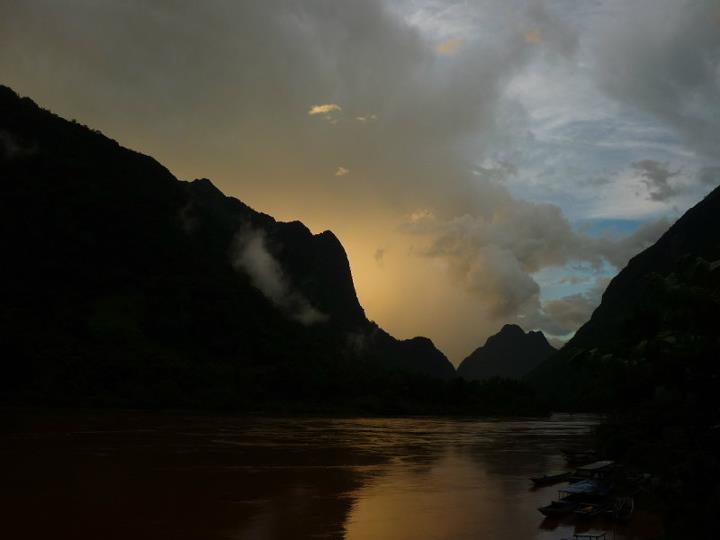 being built all the time, as it was the latest gem in the Lao traveler scene. It made us feel queasy as he explained that it was getting busier during the low season, while in the high season 3- 4 bars would compete by playing loud pop music over each other to attract customers. We sat in a bar that was incredibly well stocked considering we were out in the sticks, but soon realized that this water highway was a direct connection to Luang Prabang, which is one of the most touristy places in Laos and as such western goods and products can reach here relatively easily. We sipped 2 for 1 cocktails of Gordon’s Gin and Mojitos in a colourful lit bar, out on the stilted decking admiring the fading light disappearing behind the silhouetted, rugged mountains. We met some of Jan’s friends he had met in Thailand and discussed the merits of travel, their concerns about running out of time and what they should do with the rest of it. A topic we could now relate to with just over a month left.
 The next day we were up relatively early for breakfast eating the now usual pancakes or vegetable fried rice and thick, black coffee sweetened with condensed milk. We relaxed in our hammocks until a group decision was made to head out to visit the caves, only around 40 minutes walk away. To the end of the village street and then following the muddy path that was soiled with buffalo excrement, over small streams that fed the irrigation system continuously watering the rice paddy fields below. A man rode high on a paddy tractor, which was half sunk in the deep water, while forming a haphazard square shape, which Jan truthfully pointed out was the Laos standard of working. We came across one stream where a praying mantis was walking into the stream with some kind of work emerging from its rear, which we suspected was a parasite, as the poor thing looked driven to distraction as it floated off downstream.
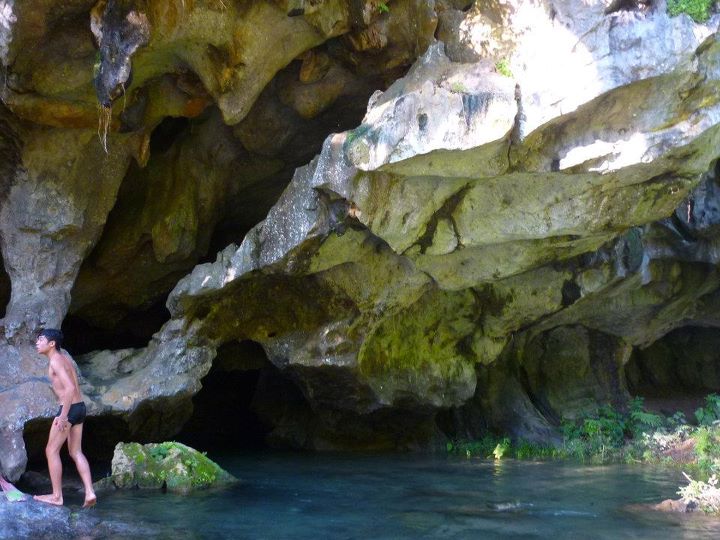
We negotiated as much mud as we could before needing to take our shoes off and faced the squelching faeces-clay through our toes before we reached a clearing and paid the local Kamu tribe a fee to visit the Tham Kaang cave. We were all sweaty as we de-robed to swim wear and hesistated before lying down in the crystal clear, icy, spring water. Heaven. The cave itself was awesome as the water gushed upwards from underground with enough force to fountain upwards a meter or so. Deposits left intricate designs and colours on the walls, as stalactites obscured the sun’s entrance into the dark cavern.
The next day we were up relatively early for breakfast eating the now usual pancakes or vegetable fried rice and thick, black coffee sweetened with condensed milk. We relaxed in our hammocks until a group decision was made to head out to visit the caves, only around 40 minutes walk away. To the end of the village street and then following the muddy path that was soiled with buffalo excrement, over small streams that fed the irrigation system continuously watering the rice paddy fields below. A man rode high on a paddy tractor, which was half sunk in the deep water, while forming a haphazard square shape, which Jan truthfully pointed out was the Laos standard of working. We came across one stream where a praying mantis was walking into the stream with some kind of work emerging from its rear, which we suspected was a parasite, as the poor thing looked driven to distraction as it floated off downstream.
We negotiated as much mud as we could before needing to take our shoes off and faced the squelching faeces-clay through our toes before we reached a clearing and paid the local Kamu tribe a fee to visit the Tham Kaang cave. We were all sweaty as we de-robed to swim wear and hesistated before lying down in the crystal clear, icy, spring water. Heaven. The cave itself was awesome as the water gushed upwards from underground with enough force to fountain upwards a meter or so. Deposits left intricate designs and colours on the walls, as stalactites obscured the sun’s entrance into the dark cavern.
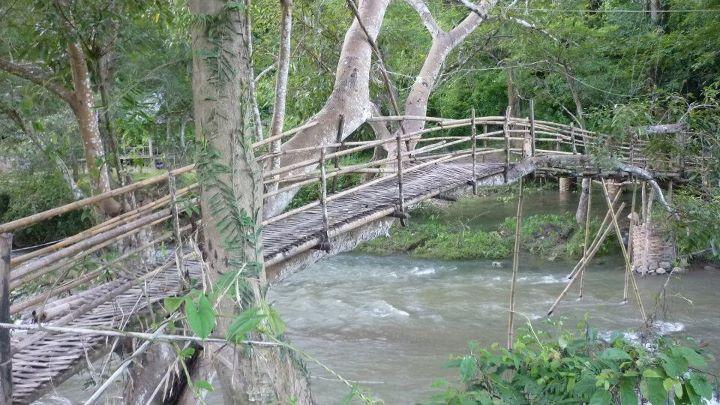 Across a well engineered bamboo bridge and the a long rope bridge part suspended, part badly supported through bamboo poles curved around a tree trunk and to the other bank, where an incredible scene and light awaited us. The low sun highlighted the
 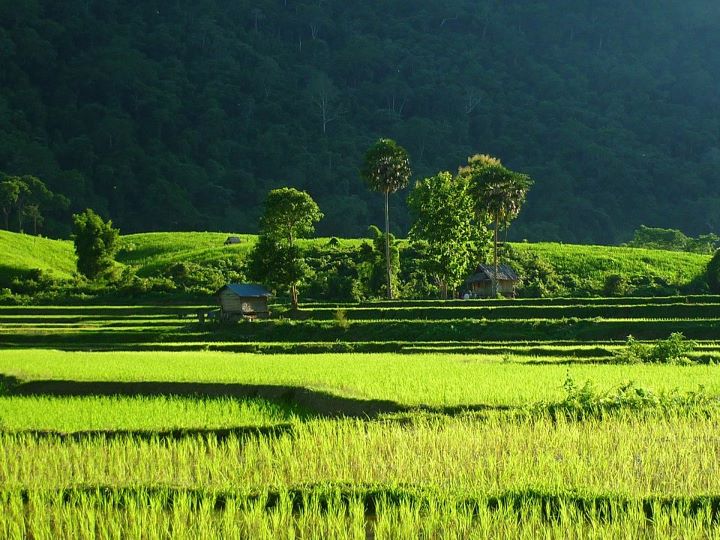 valley with iridescence and lit the rice stems in a bright yellow green that is hard to believe. Small bamboo huts that are used by the rice field farmers sat empty as the deeper green mountains watched over, partially reflected by the partially flooded, divided fields. We had a beer before setting off and Laura and I went ahead to look around another cave, part of the same complex. It ran deep and we were soon in dark with a narrow beam of light from our borrowed head torch. Echoed drips of water and faint squeaks reverberated around the numerous jagged hollows. We scrambled down a bank and reached an underground lake, still and eerie, reflecting back shimmers from the torchlight, before turning back as route options increased dramatically.
We caught up with the others and leisurely walked back in the fading light. We approached a deep puddle just after a black snake did, but having no choice but to walk through the opaque water, swallowed and continued. Arriving back in twilight we headed back to the bar to relax and enjoy our last cold drink for a long time.
The next day arrived and we were soon waiting down at the port for 10am and then loaded ourselves onto the boat before launching
valley with iridescence and lit the rice stems in a bright yellow green that is hard to believe. Small bamboo huts that are used by the rice field farmers sat empty as the deeper green mountains watched over, partially reflected by the partially flooded, divided fields. We had a beer before setting off and Laura and I went ahead to look around another cave, part of the same complex. It ran deep and we were soon in dark with a narrow beam of light from our borrowed head torch. Echoed drips of water and faint squeaks reverberated around the numerous jagged hollows. We scrambled down a bank and reached an underground lake, still and eerie, reflecting back shimmers from the torchlight, before turning back as route options increased dramatically.
We caught up with the others and leisurely walked back in the fading light. We approached a deep puddle just after a black snake did, but having no choice but to walk through the opaque water, swallowed and continued. Arriving back in twilight we headed back to the bar to relax and enjoy our last cold drink for a long time.
The next day arrived and we were soon waiting down at the port for 10am and then loaded ourselves onto the boat before launching 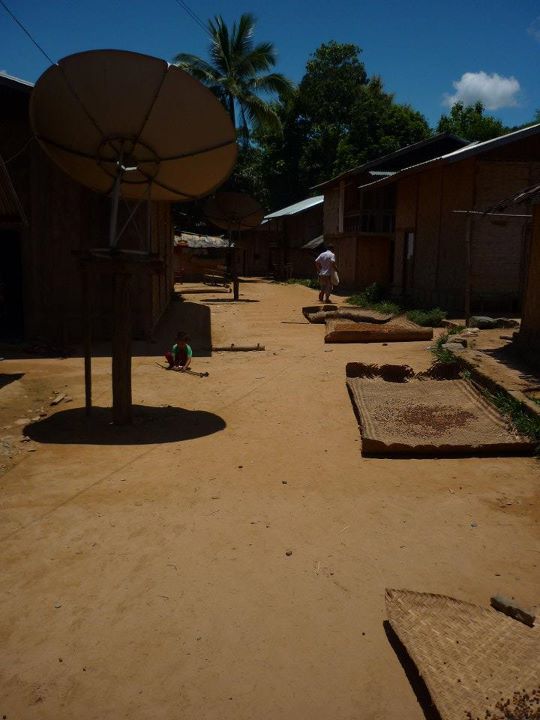 off further north, finally leaving the mass of tourists behind. After a few hours of discussing plans we slowed and rose up on a sandbank. The village was very quiet as in the heat of the day people shelter inside. The clay streets are baking hot and only a few kids hanging around under steps and flicking things with a stick take interest in our arrival. We enter a ubiquitous wooden house and sit on the floor, are served tea and take in the basic conditions. The sleeping quarters are simply created through hanging a cotton sheet around a mosquito net. At the back of the open plan room is the concrete floor kitchen with a traditional clay bucket shaped to serve as a stove, over which hung many cobs of corn and also a rack for smoking fish. A meeting Jan had with the teacher who lived there finished and we were back out, squinting in the blinding midday sun.
At the half finished school we rooted around to find everything we needed in the upcoming weeks, which to be fair was half guesswork as we were not fully sure of the scope of the task ahead. We then struggled back down the bank to load planks and buckets filled with tools aboard before setting off again. It wasn’t long before we had cruised past overhanging bamboo swaying in the breeze and along the densely vegetated banks before we cross the fast flowing Nam Ou and rode up another bank in Hatsa about to start our next adventure.
off further north, finally leaving the mass of tourists behind. After a few hours of discussing plans we slowed and rose up on a sandbank. The village was very quiet as in the heat of the day people shelter inside. The clay streets are baking hot and only a few kids hanging around under steps and flicking things with a stick take interest in our arrival. We enter a ubiquitous wooden house and sit on the floor, are served tea and take in the basic conditions. The sleeping quarters are simply created through hanging a cotton sheet around a mosquito net. At the back of the open plan room is the concrete floor kitchen with a traditional clay bucket shaped to serve as a stove, over which hung many cobs of corn and also a rack for smoking fish. A meeting Jan had with the teacher who lived there finished and we were back out, squinting in the blinding midday sun.
At the half finished school we rooted around to find everything we needed in the upcoming weeks, which to be fair was half guesswork as we were not fully sure of the scope of the task ahead. We then struggled back down the bank to load planks and buckets filled with tools aboard before setting off again. It wasn’t long before we had cruised past overhanging bamboo swaying in the breeze and along the densely vegetated banks before we cross the fast flowing Nam Ou and rode up another bank in Hatsa about to start our next adventure.
After 3 hours we hit the start of the dirt road and after an hour of rumbling along, passing rice cultivators with their massive blades, my head nodding painfully on the seat in front we reached Nong Khiaw. Jan expertly organised a tuk tuk to the other side of the river where the town was with the other travelers in the minivan and for 5,000 kip each we were dropped in the centre of town in 5 minutes, on the bank of the large Nam Ou river, where even more impressive peaks overwhelmed us. We headed directly to Meexai Guesthouse that has bungalows made from bamboo on stilts for just 20,000 kip per night for the whole place. Flowers and grass and mud adorned the outside environment as it started to spit with rain, black clouds rapidly flowing over the mountain peaks like a dolphin through water. The inside of the bungalow was well appointed as it was actually clad with plaster board, an effort usually too great for the Laotians. The bathroom was tiled and with a hammock outside on the verandah we were extremely happy. We also felt luck as our expenses were covered and so we were heading to a place that we otherwise could not have reached with our budget restrictions. We had agreed that we would really push ourselves off the beaten track and do something that challenged us to the limits and here we were, we were doing it. Anticipating excitement rushed through us as we sat taking in the scene. After a needed nap we headed over to grab something to eat from a restaurant that looked over the river and the port, which we would be stood at tomorrow to pick up a public boat to Muang Ngoi. For now however we ate well; pizza bread, noodle soup, Aurlam (a local dish made of meat, dill and wild mushrooms), fried rice and local coffee formed the veritable spread we needed with lack off food the night before and breakfast. The view was impressive as the clouds rolled in and dissipated, sun beams highlighted different parts of the landscape in ways artists dream of. The river was exceptionally high and the boats roared into life and cut across the river to begin its crawl upstream on the near side of the bank.
Satisfied we headed back to our jungle homes, daintily maneuvering across the wet, red clay and negotiated the water channels, carved into the supposed paths. Nong Khiaw is quite far off the usual traveler route, but is still heavily catered towards the ‘intrepid tourists’. This includes a newly constructed traditional steam bath and massage parlor. We booked this for the evening and relaxed for the rest of the day. As night fell we were served tea in a wooden house and wrapped ourselves up to protect against mosquitoes. We each had an hours massage (40,000 kip or £3.70) and sat in a small wooden shed filled with herbal steam (15,000 kip). Whilst taking a break outside we bumped into Francesca, a girl we met in Tad Lo a month ago, as she walked up in a towel, having just had a massage! It is funny how you end up meeting up with the same people you get along with en route, as they tend to have a similar method of travel and the same ideas as you.
We hugged and all climbed back into the steam bath excitedly chatting about what we had been up to. This continued after our massage as we went for a beer to catch up. The next day we all met again for breakfast before catching our boat further north. Jan met with the head of education for the district, as he was supporting the Bamboo School, given that it is a foundation that focuses solely on educational development. After we were introduced we set off and were soon packing ourselves on a boat with around 30 others. We took the initiative to sit up front and I sat on cool chest that meat I had my legs dangling overboard in the sun, instead of being cramped with everyone else.
The journey was immense and so beautiful, the river was extremely powerful and whole trees were being carried downstream with the force of the surging water. Eddies span off and took dead bamboo with it, hazards to the propeller that the driver had to avoid. The driver seemed quite crazed however and whenever a local needed to get off he would do a bad job at judging how fast to approach the bank. We assumed this was a big night on the Lao Lao (traditional Lao spirit). At one point he crashed up on the bank in a rage, shouting at the person sat at the back, as the boat’s frame contorted. He shouted at me to get off with one other, while he stripped off to his Y-fronts and jumped in the water to fix something at the rear. We waited for 15 minutes as he dashed around wildly, before we were ordered back on. Sat in the sun, with wind in your hair, the motor roaring as you take in the non-stop rock formations passing by and observing the vegetation with fresh eyes, knowing what the different sections are made of is unforgettable.
After an hour we turned abruptly to the right hand bank towards another, smaller village. Other wooden long boats congested the port, so men who were previously having a wash began maneuvering them to make space for our vessel. We climbed out at the bottom of the steps, excited by this new place, even more isolated in the mountains. I grabbed all the bags while Jan set off to the guesthouse he uses everytime he comes this way, which was great as he has been to many during the year and half he has been travelling up and down the Nam Ou and so secured us the best rooms facing the river (20,000 again) at Sailom Guesthouse. Our hammocks were laid out within 5 minutes of us landing, while people were still milling around trying to find somewhere and price compare.
We set out a little while after to buy a multipack of locally produced drinking water, which costs 2,000 kip each instead of 5,000- 8,000 for a Pepsi or Nestle brand, which is a completely unethical choice to be avoided, but an issue we will not go into! I also picked up some local “A” cigarettes and some fruit before retiring for another afternoon nap. We were to stay in Muang Ngoi for 2 nights, as we needed to rendez vous with a boat that Jan had privately hired.
This was to be loaded up with the blocks we needed to build a toilet block for the school in Hatsa, which was destroyed some weeks ago by a massive mango tree. We would also meet our translator onboard and go to fetch some tools that we would need from another ‘project village’ called Sup King, where the school was still being built.
We met Jan at one of the numerous bars lining the riverfront, heavily catering towards tourists. If you want a cocktail though the Riverside is the place you need. Despite being off-season there were still a fair number of people around and making it this far up the river, a feat the guidebooks suggested was rare. Nevertheless everyone from backpackers, to older people heading out on treks and even families with young children were walking around the hard mud high street. One girl around 5 years of age sat calmly while an old lady rifled through her hair, while motioning and trying to talk in English about the girl’s apparent nit problem. Jan explained later that this place was booming and new places were being built all the time, as it was the latest gem in the Lao traveler scene. It made us feel queasy as he explained that it was getting busier during the low season, while in the high season 3- 4 bars would compete by playing loud pop music over each other to attract customers. We sat in a bar that was incredibly well stocked considering we were out in the sticks, but soon realized that this water highway was a direct connection to Luang Prabang, which is one of the most touristy places in Laos and as such western goods and products can reach here relatively easily. We sipped 2 for 1 cocktails of Gordon’s Gin and Mojitos in a colourful lit bar, out on the stilted decking admiring the fading light disappearing behind the silhouetted, rugged mountains. We met some of Jan’s friends he had met in Thailand and discussed the merits of travel, their concerns about running out of time and what they should do with the rest of it. A topic we could now relate to with just over a month left.
The next day we were up relatively early for breakfast eating the now usual pancakes or vegetable fried rice and thick, black coffee sweetened with condensed milk. We relaxed in our hammocks until a group decision was made to head out to visit the caves, only around 40 minutes walk away. To the end of the village street and then following the muddy path that was soiled with buffalo excrement, over small streams that fed the irrigation system continuously watering the rice paddy fields below. A man rode high on a paddy tractor, which was half sunk in the deep water, while forming a haphazard square shape, which Jan truthfully pointed out was the Laos standard of working. We came across one stream where a praying mantis was walking into the stream with some kind of work emerging from its rear, which we suspected was a parasite, as the poor thing looked driven to distraction as it floated off downstream.
We negotiated as much mud as we could before needing to take our shoes off and faced the squelching faeces-clay through our toes before we reached a clearing and paid the local Kamu tribe a fee to visit the Tham Kaang cave. We were all sweaty as we de-robed to swim wear and hesistated before lying down in the crystal clear, icy, spring water. Heaven. The cave itself was awesome as the water gushed upwards from underground with enough force to fountain upwards a meter or so. Deposits left intricate designs and colours on the walls, as stalactites obscured the sun’s entrance into the dark cavern.
Across a well engineered bamboo bridge and the a long rope bridge part suspended, part badly supported through bamboo poles curved around a tree trunk and to the other bank, where an incredible scene and light awaited us. The low sun highlighted the valley with iridescence and lit the rice stems in a bright yellow green that is hard to believe. Small bamboo huts that are used by the rice field farmers sat empty as the deeper green mountains watched over, partially reflected by the partially flooded, divided fields. We had a beer before setting off and Laura and I went ahead to look around another cave, part of the same complex. It ran deep and we were soon in dark with a narrow beam of light from our borrowed head torch. Echoed drips of water and faint squeaks reverberated around the numerous jagged hollows. We scrambled down a bank and reached an underground lake, still and eerie, reflecting back shimmers from the torchlight, before turning back as route options increased dramatically.
We caught up with the others and leisurely walked back in the fading light. We approached a deep puddle just after a black snake did, but having no choice but to walk through the opaque water, swallowed and continued. Arriving back in twilight we headed back to the bar to relax and enjoy our last cold drink for a long time.
The next day arrived and we were soon waiting down at the port for 10am and then loaded ourselves onto the boat before launching off further north, finally leaving the mass of tourists behind. After a few hours of discussing plans we slowed and rose up on a sandbank. The village was very quiet as in the heat of the day people shelter inside. The clay streets are baking hot and only a few kids hanging around under steps and flicking things with a stick take interest in our arrival. We enter a ubiquitous wooden house and sit on the floor, are served tea and take in the basic conditions. The sleeping quarters are simply created through hanging a cotton sheet around a mosquito net. At the back of the open plan room is the concrete floor kitchen with a traditional clay bucket shaped to serve as a stove, over which hung many cobs of corn and also a rack for smoking fish. A meeting Jan had with the teacher who lived there finished and we were back out, squinting in the blinding midday sun.
At the half finished school we rooted around to find everything we needed in the upcoming weeks, which to be fair was half guesswork as we were not fully sure of the scope of the task ahead. We then struggled back down the bank to load planks and buckets filled with tools aboard before setting off again. It wasn’t long before we had cruised past overhanging bamboo swaying in the breeze and along the densely vegetated banks before we cross the fast flowing Nam Ou and rode up another bank in Hatsa about to start our next adventure.Enjoyed this story?
Read more stories from Laos→