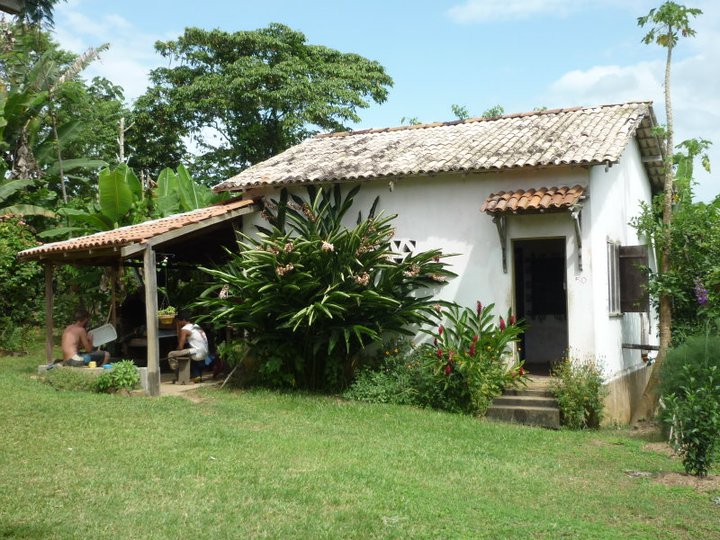
We are shown around the fazenda and told briefly what it does and some of the different areas. Our first impressions were "WOW" and "we have been looking for a place like this since India", found it in Omkareshwar but had to leave. The place is first class beauty and peace. The greens are everywhere and the constant sound of water is like music as it is so peaceful otherwise. No traffic, no electricity, water from a spring, food grown and eaten as much as possible. Aspiring to be self-sufficient in living and being able to produce cacau or chocolate seeds as a stable income this place has great ideals and shines in both this respect and in the natural sense. The video above shows just a brief start to what was a 120 hectare farm that stretched into the "Mata Atlantica", the thin forest that stretches down the East coast of Brazil. With just 7% left the farm in part aims to preserve a part of it before all of it succumbs to slash and burn farming and replaced naturally with quick grow trees and plants, called capoeira.
 After a brief tour around, including the compost toilet that produces human waste fertiliser, but built well with a chimney that draws the smell out of the roof, hammock area/ verandah, veggie garden and the out door dining table we were shown our room. Two concrete floors and walls, dark, but complete with cacau shells on the floor. We were given the privilage of a thin foam mattress, which is better than the straw mats that everyone usually uses. The next room along had resident bats and was awaiting on a new floor so we left that alone. That night we had a great time capturing what was in store for us as we ate on the roof a vegetarian feast of onion rice, chapati, the local pimenta chilli sauce famous in Bahia, tasty beans and vegetables. It was a full moon on the 21st November, which illuminated the river and under growth as we ate over looking the jungle, and waterfalls.
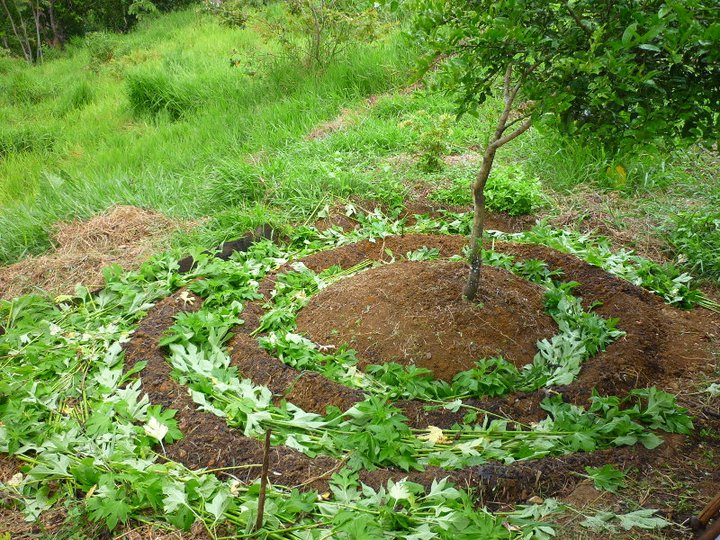
The first few days were all about settling in and trying to learn as much as possible about agro-forestary and permaculture a passion of Alex´s that you could see. Alex had been living in the farm for 10 months already, many just with Haroldo over the winter season. We learnt about his developments including keyhole gardening that give you more workable land and areas to work from, complimentary planting using plants that give back to the soil what the other plants need. We discovered the technique of molching and discovered the importance of soil quality. In the tropics 80% of nutrients are kept in the trees, while temperate areas this is just 20%, which means that cutting down trees using slash and burn, introduced by the Portugese and Spanish through Latin America destroys the soil quality, making it only good for 3 years of crop, before it turns into dense red clay.
After a brief tour around, including the compost toilet that produces human waste fertiliser, but built well with a chimney that draws the smell out of the roof, hammock area/ verandah, veggie garden and the out door dining table we were shown our room. Two concrete floors and walls, dark, but complete with cacau shells on the floor. We were given the privilage of a thin foam mattress, which is better than the straw mats that everyone usually uses. The next room along had resident bats and was awaiting on a new floor so we left that alone. That night we had a great time capturing what was in store for us as we ate on the roof a vegetarian feast of onion rice, chapati, the local pimenta chilli sauce famous in Bahia, tasty beans and vegetables. It was a full moon on the 21st November, which illuminated the river and under growth as we ate over looking the jungle, and waterfalls.
The first few days were all about settling in and trying to learn as much as possible about agro-forestary and permaculture a passion of Alex´s that you could see. Alex had been living in the farm for 10 months already, many just with Haroldo over the winter season. We learnt about his developments including keyhole gardening that give you more workable land and areas to work from, complimentary planting using plants that give back to the soil what the other plants need. We discovered the technique of molching and discovered the importance of soil quality. In the tropics 80% of nutrients are kept in the trees, while temperate areas this is just 20%, which means that cutting down trees using slash and burn, introduced by the Portugese and Spanish through Latin America destroys the soil quality, making it only good for 3 years of crop, before it turns into dense red clay.
 The detail we went into over the month and a half in this areas was truly inspiring and led a completely new understanding of how our world works in symbiosis. Getting involved with growing plants, your own food, changes the way you look at consumption and supermarket selling, which is linked by default with intensive farming methods.
The good thing about Alex and his approach, despite essentially overseeing what we were doing, instigating projects etc was that he was always ready to give advice, thoughts or knowledge on this subject. It was a continual debate, question and do process that really meant that we felt that we were developing a good knowledge on this subject ourselves, depite not being anywhere near our career path subjects. On our first few days we planted trees, and molched a new coffee plantation.
The detail we went into over the month and a half in this areas was truly inspiring and led a completely new understanding of how our world works in symbiosis. Getting involved with growing plants, your own food, changes the way you look at consumption and supermarket selling, which is linked by default with intensive farming methods.
The good thing about Alex and his approach, despite essentially overseeing what we were doing, instigating projects etc was that he was always ready to give advice, thoughts or knowledge on this subject. It was a continual debate, question and do process that really meant that we felt that we were developing a good knowledge on this subject ourselves, depite not being anywhere near our career path subjects. On our first few days we planted trees, and molched a new coffee plantation.
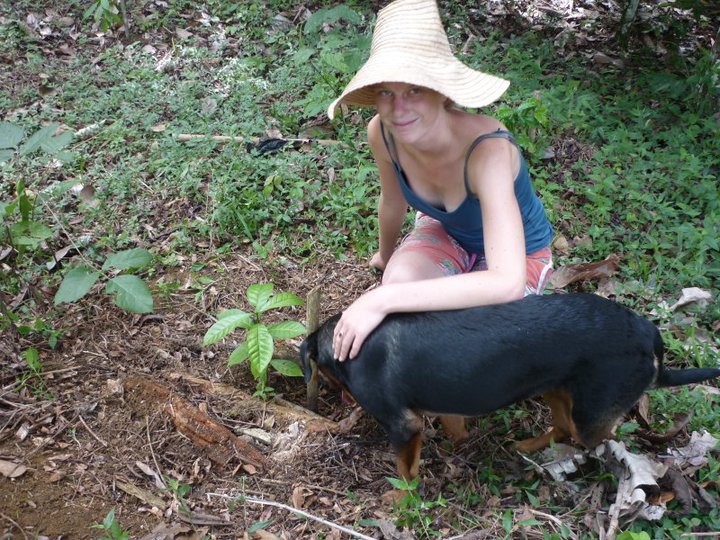 The day after we arrived two Brazilian girls, Mariana and Lux arrived. These guys were with us for the majority of time we were at Puravida. Over the next week we grew into a small family. Laura and I began taking on more and more duties in the kitchen after we had grown accustomed to the fire, stove and some of the native ingredients we had not heard of let alone cooked with!
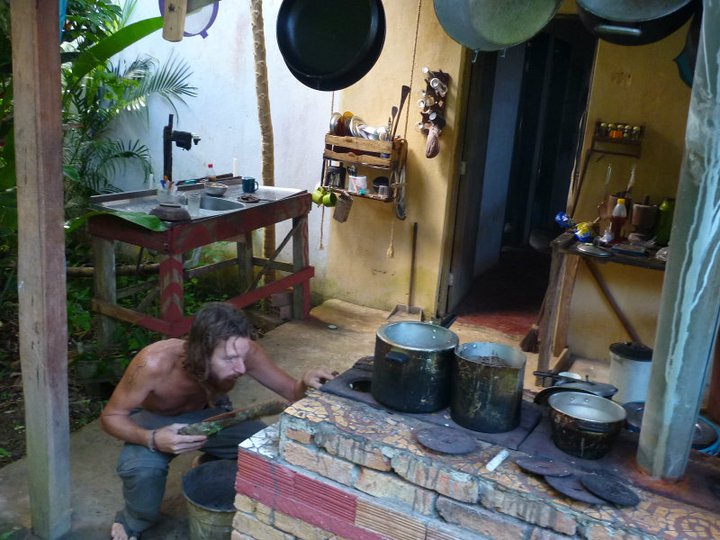 These included farofa de mandioca (thick manioc flour), ipeem, which is a thick, stodgy potato, white corn, loads of types of lentils, dried chick peas and various types of green leaf useful in salads and for cooking.
One day Alex confided how glad he was that everyone on the farm at that time was so proactive, got on with things and had such a good energy. It meant a lot because you could see how genuine the comment was. Everyone also really felt calm the place was and how close we were getting as a team through how they could get on with things, but also listen to each others advice and jump in to help others when it was needed. We were all learning, but putting a lot in at the same time. Alex mentioned that he had seen many people come and leave totally different, with new skills and aptitude for doing things and life. Skeptically and ego driven we suspected that these guys probably had little life experience to start with, but we were soon proved wrong... For example Alex was a good leader though and through numerous situations on the farm from various people I learnt a lot about leadership and how motivation is the best leader and not requirement. It is a pull rather than a push system that really gets things done in a plesant way. Laura and I were both going through a time of reflection about various things, probably as a result of the place, its innate calmness, but also the space you could take for yourself and the fact that living was stripped back to its essence. It turned out that everyone who came and left the farm was able to work on their own demons or weaknesses, whatever they may be and at least start to work through them, often with the support of other people in the group. When you are living and working with people so intensely that you have just met you have a unique, outsider persepctive that is completely different and really interesting to explore. This was a true part of the PuraVida culture.
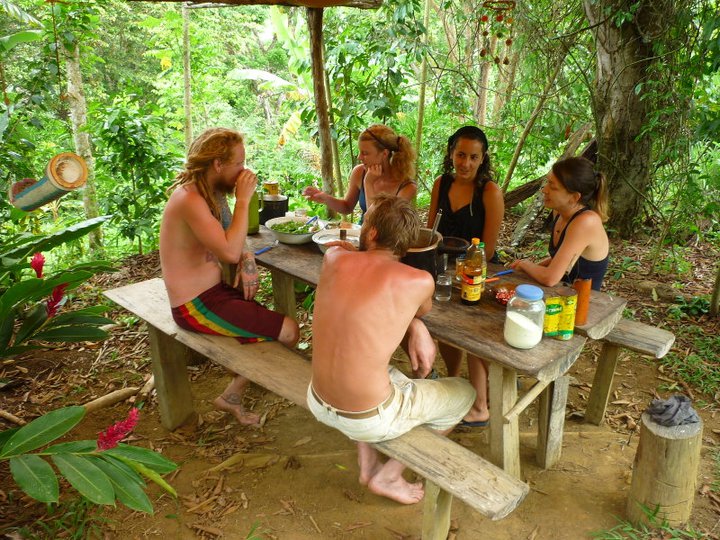
We started all meditating together in the evening time, although this was not kept too strictly to say the least as we had planned. Everyone had tried or completed a Vipassana course and were interested in meditation. As there was no electricity in the houses but a lot of bugs there was something really powerful about meditating with 5 other people to the loud trill of the cacadas by candle light. The only real routine was breakfast that was started by Alex or Simon, who were up early (I never made it up to make breakfast and was always the last up. Turns out that getting up early really is a weakness of mine!) to make coffee and porridge using a variety of grains or surprisingly corn flour and banana, which for me was the best. This was accompanied by fresh fruit grown in the garden and toasted chocolate beans.
After a few days people knew what needed to be done and got on with things, a lot of the time projects would be group based. Digging out a new irrigation stream was one example, planting a row of shade producing trees was another, where everyone took a hoe and would be digging away happily. Work never felt like work as the philosophy was "if you dont want to do it then dont". This made everyone work just because everyone else was and wanted to give equal input.
Every now and again we would be called from garden work to work in the cacau. Throughout our stay we saw the process of cacau production from start to finish. Starting with helping the farm administrator/ local person called "Netto" in charge of producing the cacau to cut down and carry the cacau pods to a pile. One patch took a day of hard carrying, with rope cutting into your shoulders under a very humid canope.
These included farofa de mandioca (thick manioc flour), ipeem, which is a thick, stodgy potato, white corn, loads of types of lentils, dried chick peas and various types of green leaf useful in salads and for cooking.
One day Alex confided how glad he was that everyone on the farm at that time was so proactive, got on with things and had such a good energy. It meant a lot because you could see how genuine the comment was. Everyone also really felt calm the place was and how close we were getting as a team through how they could get on with things, but also listen to each others advice and jump in to help others when it was needed. We were all learning, but putting a lot in at the same time. Alex mentioned that he had seen many people come and leave totally different, with new skills and aptitude for doing things and life. Skeptically and ego driven we suspected that these guys probably had little life experience to start with, but we were soon proved wrong... For example Alex was a good leader though and through numerous situations on the farm from various people I learnt a lot about leadership and how motivation is the best leader and not requirement. It is a pull rather than a push system that really gets things done in a plesant way. Laura and I were both going through a time of reflection about various things, probably as a result of the place, its innate calmness, but also the space you could take for yourself and the fact that living was stripped back to its essence. It turned out that everyone who came and left the farm was able to work on their own demons or weaknesses, whatever they may be and at least start to work through them, often with the support of other people in the group. When you are living and working with people so intensely that you have just met you have a unique, outsider persepctive that is completely different and really interesting to explore. This was a true part of the PuraVida culture.
We started all meditating together in the evening time, although this was not kept too strictly to say the least as we had planned. Everyone had tried or completed a Vipassana course and were interested in meditation. As there was no electricity in the houses but a lot of bugs there was something really powerful about meditating with 5 other people to the loud trill of the cacadas by candle light. The only real routine was breakfast that was started by Alex or Simon, who were up early (I never made it up to make breakfast and was always the last up. Turns out that getting up early really is a weakness of mine!) to make coffee and porridge using a variety of grains or surprisingly corn flour and banana, which for me was the best. This was accompanied by fresh fruit grown in the garden and toasted chocolate beans.
After a few days people knew what needed to be done and got on with things, a lot of the time projects would be group based. Digging out a new irrigation stream was one example, planting a row of shade producing trees was another, where everyone took a hoe and would be digging away happily. Work never felt like work as the philosophy was "if you dont want to do it then dont". This made everyone work just because everyone else was and wanted to give equal input.
Every now and again we would be called from garden work to work in the cacau. Throughout our stay we saw the process of cacau production from start to finish. Starting with helping the farm administrator/ local person called "Netto" in charge of producing the cacau to cut down and carry the cacau pods to a pile. One patch took a day of hard carrying, with rope cutting into your shoulders under a very humid canope.
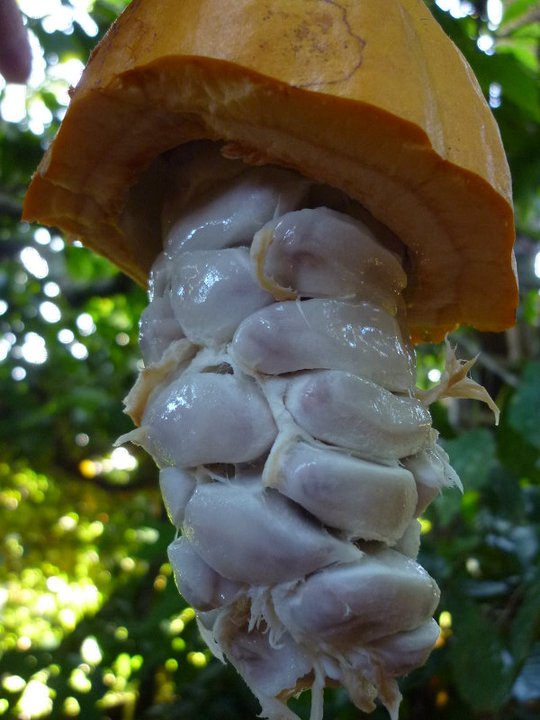 Next we helped the opening by pulling the cacau seeds out of the pod after they had been opened by the locals. This was a dangerous job as some are soft and some hard. Many people sustain deep machete cuts from this job, so we mostly removed the seeds and put them into a hand cart that was carried. Not just "over there", but down a bank for a few minutes onto a canoe, across the river, unloaded, up a steep bank and yet another for 10 minutes walking carrying perhaps 70kg of fresh cacau. This was to take it to the fermenting room for the fruit to decompose and give the cacau a stronger flavour. Next we carried numerous collections of seeds perhaps 300kg of seeds up onto the roof, or the drying room that was directly above our sleeping quarters.
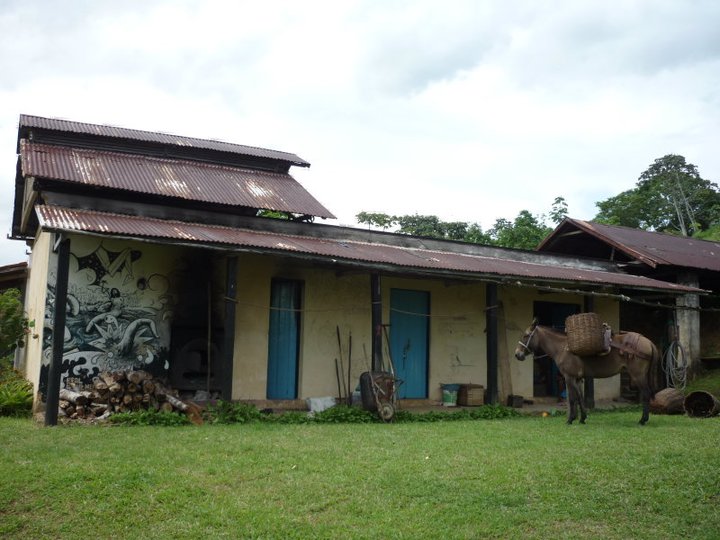 At this point the seeds are dried and turned daily, which means that 7am scraping sounds above our heads and remnants of cacau seeds falling onto our beds. After 4- 5 days we would then take all the seeds down, bag them, take them back over the river for selling.
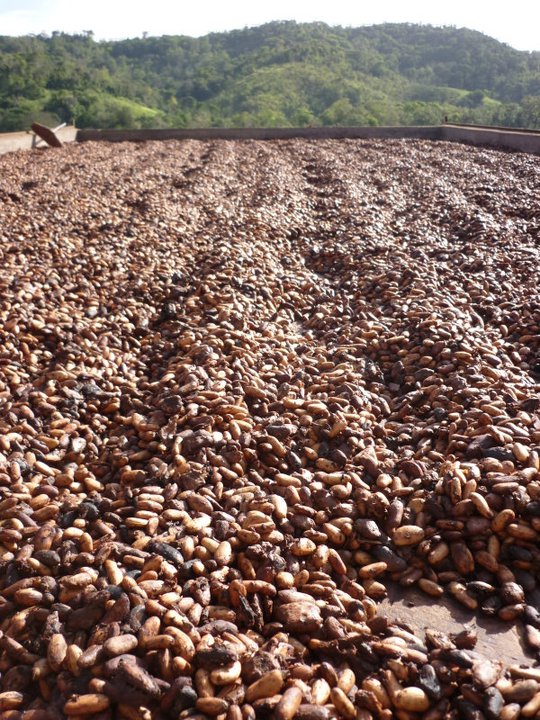 We however took a lot to the kitchen for toasting, peeling, grinding, mixing and finally eating! Loads of flavours were created during our time. Pumpkin, chilli, pepper, basil, lime, ginger, oats and more. We became pros at toasting them for the right length of time. We ate pure chocolate every day and became quite addicted to it. It is amazing the effects of pure chocolate. After lunch we would eat a fair amount and end up talking rubbish and giggling like kids fairly often, then to realise what we were doing! Natural highs.
 Having dabbled with bamboo before I left the UK, I was determined to work with bamboo a lot over the time we were in the farm. There were lots of useful agriculture and building reference books that people turned to in order to figure solutions to a problem and I took to the book on bamboo. I learnt the various joining methods and Alex taught me how to cut bamboo without splitting and shredding it apart. Cut on an angle. I found a machete that I adopted, a rusty, heavy number that was very blunt, adopted it and took to turning it into a professional tool of the jungle for all my work. It became my instrument for most things and rarely left without it. Cutting wood, splitting bamboo, hacking through the Mata grasses that cut you from the side and have hairs on the top and bottom of the leaf that tears your skin in wide patches- really nasty stuff that was prolific everywhere, cutting bananas etc. It became my jungle brother. It is funny to see what happens to people when they start wielding a machete though, but I have to say I was not one, as I was pre-aware that everyone gets the "man hacking his way through the jungle" syndrome. A few accidents happened with a lot of blood, and one where someone almost cut off the dogs leg, while I received just a nick while removing the outside of a length of bamboo. It is the stuff of childhood dreams though, cutting a path through dead wood and razor grasses, with massive soldier ants and tropical wasp nests all over the place to cut down bamboo for a jungle shelter. I was living that dream.
Laura learnt how to make dream catchers early on and this became her field of expertise, as bamboo did mine. In a week Alex asked us to combine forces and to make a 2 meter by 1 meter climber for the swamp potatoes. We made a bamboo frame and a large dreamcatcher inside using wire that was a living sculpture in the garden, which subsequently inspired everyone else to produce art works around the fazenda that integrated with the workings of the farm or plantlife that existed there. This was to be a new element that new people would be asked to contribute to. Laura and I worked together really well and we were pleased with how we worked through the task. Often these kind of projects between partners become frustrating, but we worked on each others ideas and thoughts, each worked on it equally and produced a really cool final product. This kind of thing brings you closer together as couples rarely work together on projects like this, yet we did in this case and on the cooking front (which was most days) very well. People complimented us on our strong unity and team work, which was really great to hear.
It is hard to describe an experience like this because there are so many elements and the difference between this and "real life" such an antithisis that everything was novel, interesting and challenging. I did the first period of hard labour that I have done for 11 years, using a hoe, which I have never used before, to dig and level a campsite area. This was day 6 and already having a few blisters from planting trees, ended up with 8 massive blisters on my hands and fingers, which calloused into work mans hands over the next few days. I have never had a blister under a blister before, but it hurts.
A week and a half later an Isreali guy turned up called Alesha, another great person who was an asset to the PV family. With more people we could achieve more and also have more free time to read, sit in hammocks, dance, smoke cigerettes while admiring the view and taking in the peace that was the noise of the place.
Having dabbled with bamboo before I left the UK, I was determined to work with bamboo a lot over the time we were in the farm. There were lots of useful agriculture and building reference books that people turned to in order to figure solutions to a problem and I took to the book on bamboo. I learnt the various joining methods and Alex taught me how to cut bamboo without splitting and shredding it apart. Cut on an angle. I found a machete that I adopted, a rusty, heavy number that was very blunt, adopted it and took to turning it into a professional tool of the jungle for all my work. It became my instrument for most things and rarely left without it. Cutting wood, splitting bamboo, hacking through the Mata grasses that cut you from the side and have hairs on the top and bottom of the leaf that tears your skin in wide patches- really nasty stuff that was prolific everywhere, cutting bananas etc. It became my jungle brother. It is funny to see what happens to people when they start wielding a machete though, but I have to say I was not one, as I was pre-aware that everyone gets the "man hacking his way through the jungle" syndrome. A few accidents happened with a lot of blood, and one where someone almost cut off the dogs leg, while I received just a nick while removing the outside of a length of bamboo. It is the stuff of childhood dreams though, cutting a path through dead wood and razor grasses, with massive soldier ants and tropical wasp nests all over the place to cut down bamboo for a jungle shelter. I was living that dream.
Laura learnt how to make dream catchers early on and this became her field of expertise, as bamboo did mine. In a week Alex asked us to combine forces and to make a 2 meter by 1 meter climber for the swamp potatoes. We made a bamboo frame and a large dreamcatcher inside using wire that was a living sculpture in the garden, which subsequently inspired everyone else to produce art works around the fazenda that integrated with the workings of the farm or plantlife that existed there. This was to be a new element that new people would be asked to contribute to. Laura and I worked together really well and we were pleased with how we worked through the task. Often these kind of projects between partners become frustrating, but we worked on each others ideas and thoughts, each worked on it equally and produced a really cool final product. This kind of thing brings you closer together as couples rarely work together on projects like this, yet we did in this case and on the cooking front (which was most days) very well. People complimented us on our strong unity and team work, which was really great to hear.
It is hard to describe an experience like this because there are so many elements and the difference between this and "real life" such an antithisis that everything was novel, interesting and challenging. I did the first period of hard labour that I have done for 11 years, using a hoe, which I have never used before, to dig and level a campsite area. This was day 6 and already having a few blisters from planting trees, ended up with 8 massive blisters on my hands and fingers, which calloused into work mans hands over the next few days. I have never had a blister under a blister before, but it hurts.
A week and a half later an Isreali guy turned up called Alesha, another great person who was an asset to the PV family. With more people we could achieve more and also have more free time to read, sit in hammocks, dance, smoke cigerettes while admiring the view and taking in the peace that was the noise of the place.
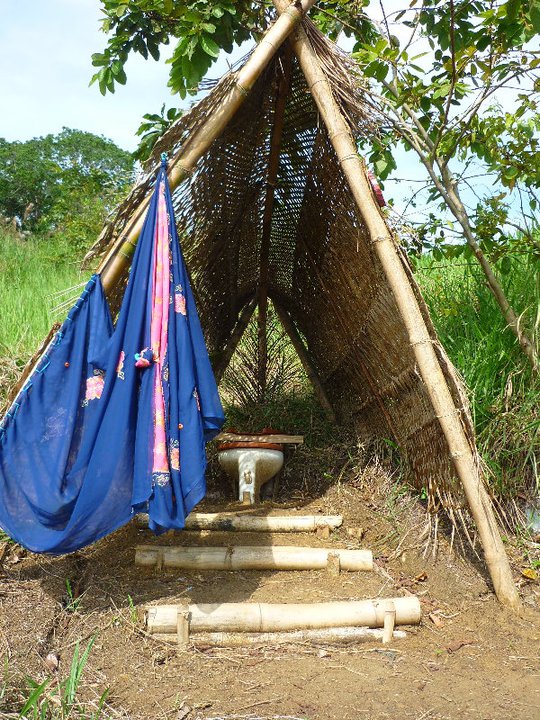 A porcelain toilet in the jungle- quality! To support this I built sewerage pipes out of bamboo to remove the waste water (only) down the bank, under the path and into the undergrowth. Then was the time to read a book on palm weaving, but as we could not take the coconut palm leaves as the trees were too young, so I had to use dendê palm. The trouble with this was the leaves were smaller, more spaced out and brittle. I devised a new method, not found in the books to make a tight weave using this palm that was far more widespread on the farm. Having worked on this and mastered the art of dende weaving everyone became more inspired by the toilet and wanted to get involved. I held a master class on weaving and we were all sat out on the verandah developing a new skill together. After a few days we had the 13 lengths we needed and so I finished the job with a bamboo structure, tied on the woven panels for the shade and privacy protection and then capped the top with thatching as reinforcement. It was a great job and was immensely rewarding for everyone to love it as much as I did.
A porcelain toilet now exists in the jungle, a legacy I could leave to the farm. Testament to the fact that it was a success was that one day Netto the farm administrator was talking to Bruno about how the farm was to develop, he saw me working and came over. Showing him the toilet produced a wide smile, positive nodding and "oltimo" or "great" in Portugese. This was the only real positivity I heard him give to any of the farm volunteers. Usually we would be doing something or he would see something, give a cheeky Netto trademarked smile, look to the ground and shake his head slowly as if to say "bloody Gringoes what are they up to now!?". This was well documented and so to get this reaction was a solid stamp of approval.
Soon the PV family grew. Bruno the founder of the farm arrived a week after Alesha and Alex left to pick up his Brazilian wife Alicelly who was due to give birth in April. A local family of 4 joined us for a weekend and used our new camping space, a day after which Patricia join us, followed by Tibaut. A few days after Adicelly arrived with Alex, another Alex (female and Belgian not male and English!) also arrived. The increase in numbers had begun.
A porcelain toilet in the jungle- quality! To support this I built sewerage pipes out of bamboo to remove the waste water (only) down the bank, under the path and into the undergrowth. Then was the time to read a book on palm weaving, but as we could not take the coconut palm leaves as the trees were too young, so I had to use dendê palm. The trouble with this was the leaves were smaller, more spaced out and brittle. I devised a new method, not found in the books to make a tight weave using this palm that was far more widespread on the farm. Having worked on this and mastered the art of dende weaving everyone became more inspired by the toilet and wanted to get involved. I held a master class on weaving and we were all sat out on the verandah developing a new skill together. After a few days we had the 13 lengths we needed and so I finished the job with a bamboo structure, tied on the woven panels for the shade and privacy protection and then capped the top with thatching as reinforcement. It was a great job and was immensely rewarding for everyone to love it as much as I did.
A porcelain toilet now exists in the jungle, a legacy I could leave to the farm. Testament to the fact that it was a success was that one day Netto the farm administrator was talking to Bruno about how the farm was to develop, he saw me working and came over. Showing him the toilet produced a wide smile, positive nodding and "oltimo" or "great" in Portugese. This was the only real positivity I heard him give to any of the farm volunteers. Usually we would be doing something or he would see something, give a cheeky Netto trademarked smile, look to the ground and shake his head slowly as if to say "bloody Gringoes what are they up to now!?". This was well documented and so to get this reaction was a solid stamp of approval.
Soon the PV family grew. Bruno the founder of the farm arrived a week after Alesha and Alex left to pick up his Brazilian wife Alicelly who was due to give birth in April. A local family of 4 joined us for a weekend and used our new camping space, a day after which Patricia join us, followed by Tibaut. A few days after Adicelly arrived with Alex, another Alex (female and Belgian not male and English!) also arrived. The increase in numbers had begun.
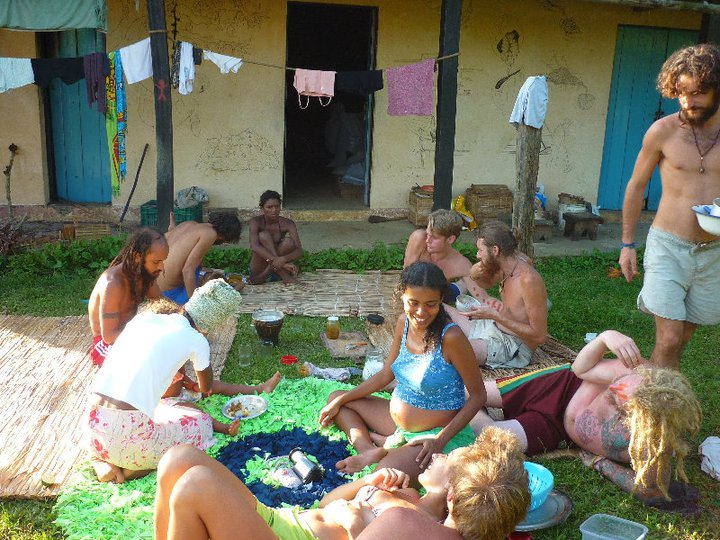 After Alex saw Max and then Sandy within a few days of each other. Soon we had our 16 people in the farm in the middle of December and in just in time for Christmas. The funny thing was that everyone had something to contribute, whether it was skills, insight, knowledge, patience etc. Sandy was an orthapedic nurse, Bruno ran the fazenda and had really interesting thoughts on the structure of society. Patricia had contact juggling and batton skills, Laura and I were the cooks. The dynamic changed but not in the negative as we had perhaps thought. We all still geled as a team and worked together, while enjoying the same moments. We also had more time to enjoy ourselves while things still happened that needed to. Some people read, some danced, some learnt new skills.
We discussed the farm with Bruno who had been away trying to secure the capital to continue. In the 1980´s a disease called "bruja" or witch´s finger hit the caucau farms. This devastated the industry. The Brazilian givernment gave loans to pay for a "cure" that never worked, but the debt remained. Bruno bought the farm with a large 250,000 Rs (100,000 pound) debt, fought off the debt due to being unfair since the cure never worked, but recently lost. He spent 6 months raising funds to keep the farm going, save the 4 workers and their families livilyhood and a large amount of Mata Altlantica jungle. He came back mentally drained as the deadline for the first large payment was due at the end of the year. Financial reality always exists it seems even when self-sufficiency is the goal away from the cash economy. The guys were working on a new eco community model bound together with mutual input and respect for each person and the land they live on. For us it was working, at least on a temporary basis. The trouble with a debt though is that it needs paying and so some kind of revenue generation is required. How do you achieve that sensitively without affecting the balance of community? Laura and I were not paying and yet Alesha was. Some paid more and some paid less, but was this fair as we were all working equally. The question was can you charge for volunteering? Other ideas were to build and rent out eco lodges, or to run farm work shops where people, like us, learnt agro-forestry and permiculture skills.
This is one side to the development of an eco community. The next was how to build and grow a village type environment where people could get what they wanted out of life, while working to support themselves on the same land and live a fulfilling but environmentally sound lifestyle. Some people are perhaps lazy, some want a big house, some want x versus y. It is difficult, as a frame work needs producing, but then having a frame work creates a heirarchy that is against the model of "working together to support each other". I, like others at the farm think it is a model that is worth exploring in wider society. Yet it turns out there are laws restricting the setting up and living in eco villages. Papers need filling in, things need paying and "civilised society" needs to be asked for permission. How is that possible? We spent a while debating these things over candle light with no definate answers.
After 3 and a half weeks Laura and I had to leave the farm to sort out our own society baseds problems. Banks and forms need signing, people need contacting to do something that means that someone else can do something else. The entangled web of bureaucracy was looming. We headed to Itacare on the coast for a good Internet connection and everyone waved us off emphatically. Our first exposure to the rest of the world in a while was now...
After Alex saw Max and then Sandy within a few days of each other. Soon we had our 16 people in the farm in the middle of December and in just in time for Christmas. The funny thing was that everyone had something to contribute, whether it was skills, insight, knowledge, patience etc. Sandy was an orthapedic nurse, Bruno ran the fazenda and had really interesting thoughts on the structure of society. Patricia had contact juggling and batton skills, Laura and I were the cooks. The dynamic changed but not in the negative as we had perhaps thought. We all still geled as a team and worked together, while enjoying the same moments. We also had more time to enjoy ourselves while things still happened that needed to. Some people read, some danced, some learnt new skills.
We discussed the farm with Bruno who had been away trying to secure the capital to continue. In the 1980´s a disease called "bruja" or witch´s finger hit the caucau farms. This devastated the industry. The Brazilian givernment gave loans to pay for a "cure" that never worked, but the debt remained. Bruno bought the farm with a large 250,000 Rs (100,000 pound) debt, fought off the debt due to being unfair since the cure never worked, but recently lost. He spent 6 months raising funds to keep the farm going, save the 4 workers and their families livilyhood and a large amount of Mata Altlantica jungle. He came back mentally drained as the deadline for the first large payment was due at the end of the year. Financial reality always exists it seems even when self-sufficiency is the goal away from the cash economy. The guys were working on a new eco community model bound together with mutual input and respect for each person and the land they live on. For us it was working, at least on a temporary basis. The trouble with a debt though is that it needs paying and so some kind of revenue generation is required. How do you achieve that sensitively without affecting the balance of community? Laura and I were not paying and yet Alesha was. Some paid more and some paid less, but was this fair as we were all working equally. The question was can you charge for volunteering? Other ideas were to build and rent out eco lodges, or to run farm work shops where people, like us, learnt agro-forestry and permiculture skills.
This is one side to the development of an eco community. The next was how to build and grow a village type environment where people could get what they wanted out of life, while working to support themselves on the same land and live a fulfilling but environmentally sound lifestyle. Some people are perhaps lazy, some want a big house, some want x versus y. It is difficult, as a frame work needs producing, but then having a frame work creates a heirarchy that is against the model of "working together to support each other". I, like others at the farm think it is a model that is worth exploring in wider society. Yet it turns out there are laws restricting the setting up and living in eco villages. Papers need filling in, things need paying and "civilised society" needs to be asked for permission. How is that possible? We spent a while debating these things over candle light with no definate answers.
After 3 and a half weeks Laura and I had to leave the farm to sort out our own society baseds problems. Banks and forms need signing, people need contacting to do something that means that someone else can do something else. The entangled web of bureaucracy was looming. We headed to Itacare on the coast for a good Internet connection and everyone waved us off emphatically. Our first exposure to the rest of the world in a while was now...
Enjoyed this story?
Read more stories from Brazil→More from Brazil
Related Stories
Ingredients around the world - Tapioca
Tapioca is the name of the white starch extracted from the Cassava plant. Tapioca generally refers...
24 March 2023
Securing value accommodation around the world
Flights, accommodation and activities tend to be the biggest expenses when travelling. Securing...
23 November 2022
Explore Your World...
----------------------------------------------------------------------------------------------------...
5 January 2022