Training & Growth
Building the architecture that turns an intern into a reliable operator.
The Psychology
“Growing confidence. "Now I understand — I need to train this thing properly."”
The Reality
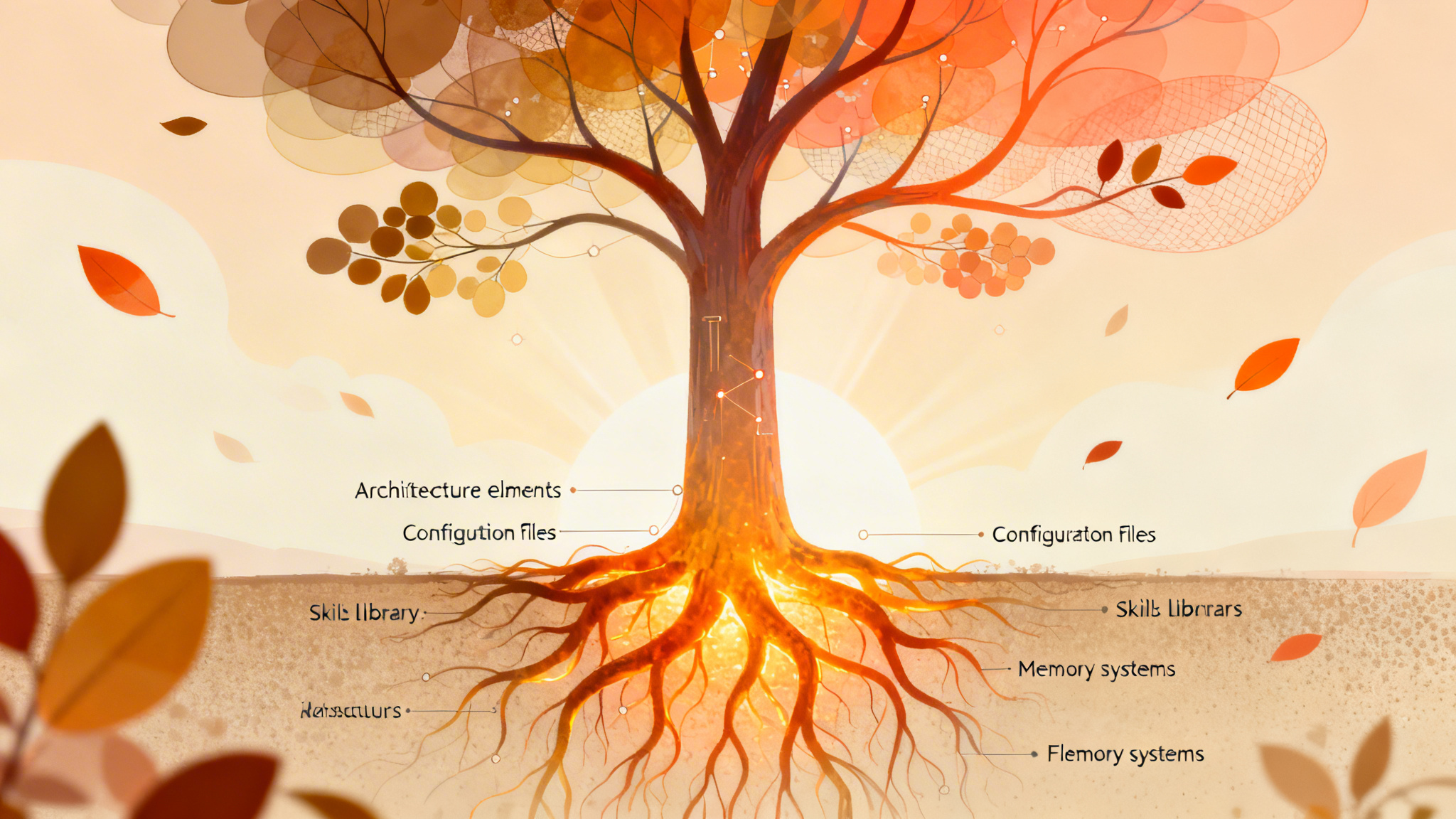
This is where the real work happens. Building proper architecture, file structures, progressive disclosure, and the knowledge base that makes AI genuinely useful.
From the Trenches
Real words from real sessions
“Your master data files basically are the lens that you're expecting Claude to look at the LLM through and adhere... the map of the territory that it's supposed to be using to navigate its way through.”
“We need to focus on building the 'engine room' or core system, likening it to building train tracks before the train arrives.”
“Initial efforts may take 80% of the time, the speed of iteration increases as understanding grows.”
What You'll Build
7 modules in this phase
File Structure Architecture for AI Brains
How you organise files determines how effectively AI can find and use information. Learn the directory patterns that scale: context/, code/, customers/, projects/, .claude/skills/.
Deliverables
- Complete directory structure implemented
- Folder-level CLAUDE.md files for context
- Clear separation of concerns
- README files for each major directory
Frequently Asked Questions
Why does file structure matter so much for Claude Code?
Claude Code reads files to understand your business. If your files are scattered, duplicated, or poorly named, Claude Code wastes its context window finding information and may use outdated versions. A clean file structure is like a well-organised office: everyone, including AI, finds what they need faster.
What does an ideal project structure look like?
The ideal structure separates concerns: a context folder for business knowledge, a skills folder for reusable instructions, a customers folder for client-specific data, and a projects folder for active work. Each folder has a clear purpose and nothing is duplicated. This module provides a complete template you can adopt immediately.
How do I reorganise an existing messy project without breaking things?
Incrementally. Start by creating the target structure alongside your existing files, then move files one folder at a time, updating any references as you go. Claude Code can help with the migration itself. Never attempt a big-bang reorganisation; it creates more problems than it solves.
Should every team member use the same file structure?
Yes. When your CLAUDE.md references specific file paths, every team member needs those files in the same relative locations. Use version control to ensure consistency. If Ross's machine has files in different places than yours, Claude Code will produce different results for each person.
Progressive Disclosure Design Patterns
AI doesn't need to know everything at once. Progressive disclosure feeds context in layers: CLAUDE.md → folder CLAUDE.md → SKILL.md → specification files. Less noise, better output.
Deliverables
- Multi-layer context architecture
- CLAUDE.md optimised for top-level rules only
- Folder-level context files for domain-specific rules
- Specification files for detailed requirements
Frequently Asked Questions
What is progressive disclosure in the context of Claude Code?
Progressive disclosure means giving Claude Code only the information it needs for the current task rather than loading everything at once. Your CLAUDE.md references detailed files that Claude Code reads on demand. This keeps the main instruction file manageable while making deep knowledge available when required.
Why not just put everything in one large CLAUDE.md?
Claude Code has a finite context window. A 2,000-line CLAUDE.md consumes valuable space that should be used for the actual task. Progressive disclosure keeps your CLAUDE.md concise and lets Claude Code pull in detailed specifications, brand guidelines, or client data only when the current task requires them.
How do I decide what goes in CLAUDE.md versus separate files?
CLAUDE.md should contain rules that apply to every task: brand colours, spelling conventions, security rules, and critical overrides. Anything that applies only to specific tasks, such as report templates, client details, or technical specifications, goes in separate files that CLAUDE.md references by path.
Can Claude Code read files that are not referenced in CLAUDE.md?
Yes. Claude Code can read any file in your project when asked or when it determines a file is relevant. But files referenced in CLAUDE.md are read automatically at the start of every conversation. The pattern is: must-know information in CLAUDE.md, should-know information in referenced files, and can-know information in the broader project.
Advanced Skill Creation Framework
Move beyond simple skills to composable, parameterised, multi-step skills that orchestrate complex business processes. Skills that call other skills. Skills that verify their own output.
Deliverables
- 10+ production skills across multiple business functions
- Skill composition patterns
- Self-verifying skill architecture
- Skill documentation standards
Frequently Asked Questions
How do advanced skills differ from the basic skills I built in Phase 1?
Advanced skills include input validation, error handling, multi-step workflows, and output verification built into the skill itself. A basic skill says 'write a report.' An advanced skill specifies the data sources to read, the analysis to perform, the format to produce, the verification checks to run, and what to do if any step fails.
What is a multi-step skill workflow?
A skill that breaks complex tasks into sequential phases with checkpoints. For example, a client audit skill might have five steps: gather data, analyse performance, identify issues, draft recommendations, and format the report. Each step has defined inputs and outputs, and the skill specifies what must be verified before moving to the next step.
How do I test advanced skills reliably?
Use a three-tier testing approach: test with known good input to verify the happy path, test with edge-case input to verify error handling, and test with deliberately bad input to verify the skill rejects it gracefully. Document your test cases alongside the skill so anyone on your team can re-run them.
When should I refactor an existing skill versus creating a new one?
Refactor when the skill's core purpose is the same but the implementation needs improvement. Create a new skill when you need fundamentally different behaviour. If you find yourself adding conditional branches like 'if this type of client, do X, otherwise do Y,' that is usually a sign you need two separate skills.
Can skills interact with external APIs and services?
Yes. Advanced skills can instruct Claude Code to call APIs, query databases, read spreadsheets, and interact with external services. The skill defines the integration pattern, authentication approach, error handling, and data transformation. This module covers secure integration patterns that keep credentials out of your skill files.
Memory and Learning Systems
AI conversations are ephemeral by default. Build persistent memory systems that let your AI brain learn across sessions — remembering solutions, avoiding repeated mistakes, building institutional knowledge.
Deliverables
- MEMORY.md auto-save system
- Topic-based memory files
- Cross-session learning patterns
- Memory maintenance protocols
Frequently Asked Questions
What do you mean by 'memory' in Claude Code?
Claude Code does not retain information between conversations by default. Memory systems are files and structures you create so that Claude Code can learn from past work. A MEMORY.md file records key lessons, solved problems, and important decisions. Claude Code reads this at the start of each conversation, effectively remembering what it learned before.
How is this different from just keeping good notes?
Good notes are written for humans. Memory files are structured for Claude Code to parse and act on efficiently. They use consistent formats, categorise information by topic, and include specific technical details that Claude Code needs. The module teaches you a format that serves both human readers and Claude Code equally well.
How do I prevent the memory file from growing too large?
Set a line limit and enforce it. When MEMORY.md approaches the limit, move detailed entries into topic-specific files and keep MEMORY.md as a concise index with pointers. The module teaches a pruning discipline: every month, review entries and archive anything that is no longer actively relevant.
Can Claude Code update its own memory file?
Yes, and this is one of the most powerful patterns in the framework. You can instruct Claude Code to append key learnings to MEMORY.md at the end of significant tasks. Over time, the system genuinely learns from experience. The module covers how to structure this self-updating behaviour safely.
Multi-Project Management
Running multiple projects simultaneously without context bleed. Customer directories, project isolation, shared utilities, and the handoff patterns that keep everything clean.
Deliverables
- Customer directory structure (per-client configs)
- Project isolation patterns
- Shared utility library
- Context handoff system for long-running work
Frequently Asked Questions
How do I use Claude Code across multiple client projects simultaneously?
Each client project gets its own directory with its own CLAUDE.md, skills, and context files. You run separate Claude Code sessions for each project. Shared resources like brand guidelines and common skills live in a central location referenced by each project's CLAUDE.md. This module covers the architecture for managing ten or more projects cleanly.
Can Claude Code context from one project leak into another?
Not if your file structure is correct. Each Claude Code conversation operates within a specific project directory and reads that project's CLAUDE.md. Cross-project contamination happens when people use a single flat directory for everything. Proper project isolation, which this module teaches, prevents it entirely.
How do I maintain consistency across projects?
Use shared skill files and a global CLAUDE.md for universal rules. Project-specific CLAUDE.md files inherit the global rules and add project-specific overrides. When you improve a skill, every project benefits immediately. This is the same pattern used by software teams managing shared libraries.
What happens when I need to switch between projects quickly?
Open separate terminal windows, one per project. Each session loads its own context independently. There is no warm-up penalty for switching because Claude Code reads the CLAUDE.md fresh each conversation. The module covers practical workspace layouts for managing multiple concurrent projects efficiently.
Building Business Context Files
Team profiles, client information, process documentation, integration guides — the knowledge base that turns a generic AI into YOUR business's AI.
Deliverables
- Team profiles with roles and responsibilities
- Client configuration files
- Process documentation
- Integration reference guides
Frequently Asked Questions
What is a business context file?
A structured document that captures everything Claude Code needs to know about a specific aspect of your business: your services, pricing, team structure, client relationships, market positioning, or operational processes. It is your institutional knowledge written in a format that Claude Code can use to make informed decisions.
How much business information should I share with Claude Code?
Share everything that is relevant to the tasks you want Claude Code to perform, excluding sensitive credentials. If Claude Code writes client emails, it needs to know your service offerings and tone. If it generates reports, it needs to know your analysis methodology. Incomplete context produces generic output.
How do I write context files that Claude Code actually uses effectively?
Use clear headings, structured tables, and explicit rules rather than narrative prose. Claude Code parses structured content more reliably than flowing paragraphs. State facts directly: 'Primary market: United Kingdom. Currency: GBP. Date format: DD/MM/YYYY.' This module provides templates for every common context type.
How often should I update business context files?
Whenever the underlying facts change. Add a review schedule to your operations: monthly for client details, quarterly for service offerings, and immediately for any significant business change. Outdated context files produce outdated outputs. The module includes a maintenance checklist to keep your context current.
Can Claude Code help me build these context files?
Yes, and it is excellent at it. You can have a conversation where you describe your business verbally and Claude Code structures the information into properly formatted context files. You then review and correct any inaccuracies. This is one of the most efficient ways to bootstrap your business knowledge base.
Integration Patterns
Connecting AI to APIs, databases, external services. From Google Ads to BigQuery to email — the plumbing that makes AI operationally useful, not just a text generator.
Deliverables
- API integration patterns
- Database connection architecture
- Credential management (secure, not hardcoded)
- External service authentication flows
Frequently Asked Questions
What kinds of external systems can Claude Code integrate with?
Claude Code can work with APIs, databases, spreadsheets, email systems, cloud storage, analytics platforms, advertising platforms, and most services that have a command-line interface or API. This module covers the most common business integrations: Google Workspace, CRM systems, analytics, and marketing platforms.
Do I need a developer to set up integrations?
For basic integrations like reading Google Sheets or querying a database, no. Claude Code can help you write the connection scripts. For complex integrations involving OAuth flows, webhook endpoints, or custom APIs, you may need some technical support for the initial setup. This module teaches you to assess which integrations you can handle yourself.
How do I keep integrations secure?
Store all credentials in environment variables or dedicated credential files that are never committed to version control. Use service accounts with minimum necessary permissions. Never put API keys in your CLAUDE.md, skill files, or any file that might be shared. This module covers secure credential management patterns in detail.
What happens when an external service changes its API?
Your integration breaks, and Claude Code will report the error. The advantage of having Claude Code manage your integrations is that it can often diagnose and fix API changes faster than doing it manually. Keep your integration patterns documented in specification files so Claude Code knows the expected behaviour and can identify what changed.
War Stories
Real examples from CoffeeBrain
These aren't hypothetical scenarios. Every story happened. Every lesson was learned the hard way.
From 5 Skills to 87
CoffeeBrain's skill library grew from 5 basic tools to 87 production skills spanning Google Ads automation, PDF report generation, market intelligence, client audits, website testing, and more. Each skill built on patterns established by previous ones.
Lesson learned:
Growth is exponential when architecture is right. Each new skill takes less time because the patterns, templates, and conventions are already established.
The 517-Line Constitution
CoffeeBrain's CLAUDE.md grew to 517 lines with 11 CRITICAL rules — covering data verification, brand guidelines, deployment safety, credential management, and team access control. Every rule exists because something went wrong without it.
Lesson learned:
Your CLAUDE.md is a living document. Every failure teaches you a new rule. By Phase 3, it becomes the most important file in your system.
Simon's Multi-Harness Architecture
By week 5, Simon had evolved from a single project to a sophisticated multi-harness system: 'Brain' (top-level thinking), 'HSN' (portfolio management), 'Gym' and 'Espresso' (individual sites). Each with its own context, connected through a shared architecture.
Lesson learned:
Phase 3 is where architecture discipline pays off. The pattern of 'one brain, many projects' scales because each domain has clear boundaries.
Included Skills
Downloadable Claude Code skills
Pre-built, production-tested skills you can install directly into your Claude Code environment.
- Skill creator (advanced)
- File structure templates
- Memory management system
- Consolidation audit tool
- Progressive disclosure framework
- Client config generator
- Integration boilerplate pack
Outcomes
By the end of this phase
Clear, measurable outcomes that prove you've completed this phase and are ready for the next.
- Properly structured AI brain with clear architecture
- 10+ production skills across business functions
- Persistent memory and learning systems
- Multi-project management capability
- Complete business context knowledge base
- API and database integrations operational
- AI understands your business agenda
Knowledge Check
Phase 3 Test
20 questions to verify your understanding of Training & Growth.
Why is a well-organised directory structure critical when working with Claude Code?
What is the purpose of a 'context/' directory in a Claude Code project?
You have client-specific data for 8 different customers. How should this be organised?
What is 'progressive disclosure' in the context of Claude Code configuration?
If a folder-level CLAUDE.md contradicts the root CLAUDE.md, which takes precedence?
A developer joins the team and asks 'where do I start reading to understand this project?' What is the correct answer?
What makes a skill 'composable'?
What does it mean for a skill to be 'parameterised'?
How should a self-verifying skill handle a verification failure?
What is the purpose of MEMORY.md in a Claude Code project?
MEMORY.md has grown to 300 lines and is becoming unwieldy. What is the recommended approach?
A lesson from a production incident should be recorded in:
You manage 5 client projects. What prevents Claude Code from accidentally applying Client A's brand guidelines to Client B's report?
Why should project-related files (scripts, screenshots, test data) stay inside their project folder rather than the repository root?
What should a team profile document contain for Claude Code to use effectively?
Client configuration files should contain which of the following?
When integrating Claude Code with an external API, where should credentials be stored?
A skill needs to query a database and include the results in a report. What is the safest pattern?
You want Claude Code to send emails on behalf of your business. What safeguard is most important?
At the end of Phase 3, what distinguishes a business at this level from one that just finished Phase 1?
0/20 questions answered
Ready to start Phase 3?
Whether you're going self-service or want hands-on guidance, I'll help you get through Training & Growth with confidence.